FCS Response to Ofcom’s discussion paper ‘Connectivity you can count on’ Introduction and Overview
The FCS welcomes Ofcom’s discussion paper on the mobile market and agrees that the mobile market is increasingly important to the UK economy.
The FCS represents companies which provide professional communications solutions to business users. Our members deliver telecommunications services via mobile and fixed line telephony networks, broadband, satellite, wi-fi and business radio. Our members’ customers range from SMEs, home-workers and micro-businesses up to the very largest private enterprises and public sector users. The FCS is the largest trade organisation in the professional communications arena, representing the interests of circa 350 businesses which supply B2B services nationwide.
Businesses use mobile technology across numerous applications to enhance products and services that are used every day in hundreds of different ways. Mobile communication is becoming increasingly important to businesses, particularly to SMEs, which are the growth engine of the UK economy.
The FCS believes that Ofcom should look at connectivity across the sector, rather than solely in the mobile market. Given the alignment of fixed and mobile infrastructure and the unification of networks using IP technology, there needs to be a wider view taken of the communications market. In short, communication infrastructure should not be viewed and regulated in silos.
The review should also include new technologies; satellite technology, for example, is becoming increasingly important, especially in rural locations, and our members are reporting difficulties in gaining access to products and services in this area. It is important that Ofcom does not allow large tech companies to create monopolies that harm customers.
Given the FCS’s role as a trade association, we have not answered the individual questions contained in the review but have instead highlighted several key policy areas that are important to our members. As well as our over-arching comments on the market, we make a couple of specific points regarding satellite access, mobile termination rates and network roaming.
In summary, good connectivity is essential to UK plc growth and the regulatory environment should fully support competition, whilst incentivising investment. The FCS believes Ofcom should pay particular attention to the following points raised by our members, to ensure that every business customer has access to connectivity they can count on:
- Ensuring that the underlying regulatory framework supports competition and full access to connectivity, by mandating wholesale access to mobile networks
- Ensuring that connectivity is considered in the round, and that access to the increasingly important satellite market is available to smaller CPs/resellers
- Addressing concerns about current and future capacity
- Ensuring that connectivity is future-proofed with appropriate investment in new technologies supported by the regulatory regime
- Ensuring that the needs of business customers are taken into account
- Reviewing the approach to national roaming to give the best possible connectivity to consumers and businesses; and
- Reviewing the approach to mobile termination rates.
Importance of the complex supply chain
The complex supply chain is often misunderstood, and sometimes ignored, when making regulatory decisions. In essence, smaller Communication Providers (CPs)/ Managed Service Providers (MSPs)/resellers take inputs from various sources including fixed lines, broadband, mobile, VOIP, IT applications, security services, handsets and equipment, to provide the products and services that customers want.
In its simplest form, this could be the provision of just one service, such as broadband connectivity, but in most cases several services are bundled together and can also include nontelecom services, such as billing and even customer services. The complex supply chain is most often seen in the business market and can provide tailored, innovative solutions in a flexible and customer-centric way that differentiates it from the larger providers. It is vital that the chain functions effectively to ensure that the UK economy thrives.
An illustration of the complex supply chain is given below:
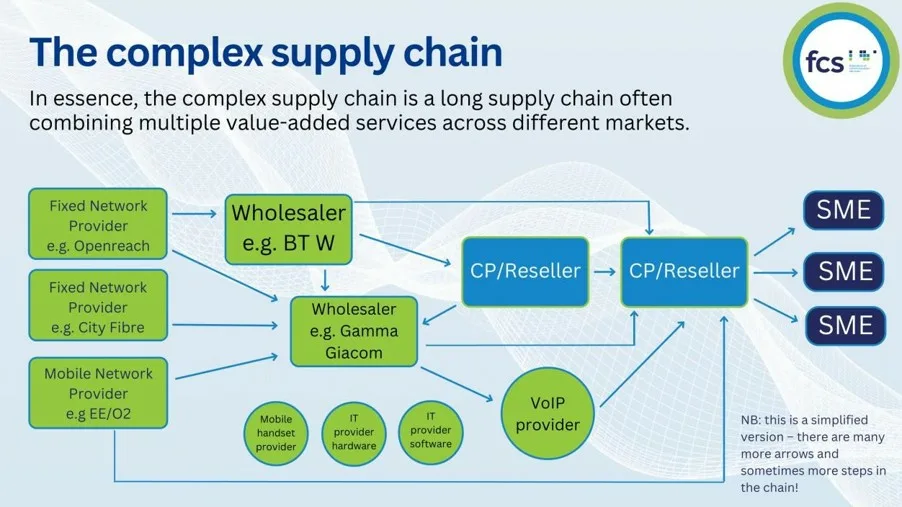
Our members stress that business customers particularly highlight the value provided by local resellers/CP/MSPs. The complex supply chain helps to fulfil the role of trusted advisor to SMEs when it comes to technology purchasing decisions, and close relationships with local service providers help SMEs to identify the most suitable tools and most appropriate pace of technology adoption to support their growth. This position is also seen in the results of the UK Government’s 2025 report[1] on SME digital adoption, which states that SMEs “value reliable, personalised support and advice” when adopting digital technologies and that SMEs often turn to trusted advisors to guide technology decisions. The FCS believes that local IT service providers, CP/MSPs and resellers often fill this role in practice.
The vibrancy of the communications market can be seen by the thousands of small providers/resellers that support the business market. The ability to provide bespoke solutions in a fleet of foot way and to understand the needs of SMEs is a key reason for this dynamism, but the regulatory regime has also played its part. Given their size, smaller MSPs/CPs/resellers have little purchasing power in the wholesale market and regulatory safeguards are, therefore, essential to ensure competition. The requirement on Openreach to provide its products and services on an Equivalence of Input (EoI) basis has helped to ensure a level playing field which means that smaller MSPs/CPs/resellers can compete with BT Retail and the other large providers in the provision of fixed line/broadband.
In contrast, in the mobile market there are currently no requirements for the MNOs to provide wholesale services on an EoI basis, and indeed, in many cases, no obligations to provide them at all. The FCS believes that access to mobile services on a fair and reasonable basis should be a right, not a gift and we urge Ofcom to address these concerns in any further work in the connectivity market.
The business market is different to the consumer market and too often the needs of business customers are overlooked. The regulatory regime in place for consumer customers does not necessarily serve the needs of business customers and it is important that the distinction is understood when driving regulatory policy.
Business Customers
The FCS believes that Ofcom is right to delve into customer requirements of connectivity in different areas and supports Ofcom’s approach in this discussion document. We understand the potential differing needs of customers when considering connectivity in busy areas, in indoor shared spaces, on trains and in rural areas. The FCS would also like to stress the need to look at the needs of both consumers and business customers as it can be easy to assume that the needs of these two groups are always the same. The FCS believes that there should be additional research and data gathering in the business market.
A supportive regulatory environment
As well as looking at customer requirements and the conditions needed to encourage investment in infrastructure and networks, it is important that Ofcom looks at the underpinning regulatory environment, as it is currently not helping smaller CPs/MSPs/resellers. The FCS believes that there is work to do to ensure that the mobile/connectivity market works as effectively as possible to support the many small CPs/MSPs and resellers that are so important in the business market. There is a tendency to think about the mobile market solely from the point of view of the big three Mobile Network Operators (MNOs) and, as all three MNOs are now both vertically and horizontally integrated, the danger of doing so has never been greater. Horizontal integration through mergers with fixed-line network operators can have a significant bearing on market competitiveness across fixed and mobile services. Additionally, given the alignment of fixed and mobile infrastructure and the unification of networks using IP technology, there needs to be a wider view taken of the communications market. In short, communication infrastructure should not be treated and regulated in silos.
The FCS urges Ofcom to adopt a technology-neutral framework and consider the implications of regulation throughout the complex supply chain, ensuring that fair and reasonable wholesale access to all connectivity services is a right and not a gift. The UK economy needs a vibrant communications market, and this can only be achieved if there is a supportive regulatory regime in place that allows the complex supply chain to flourish.
One specific area for Ofcom consideration raised by FCS members, relates to mobile termination rates. Some members believe that these are allowing cross-subsidies to be used by the big MNOs to the detriment of competition, which ultimately has an impact on customer service, choice and price. Mobile termination rates were introduced when mobile networks were first deployed to help with network deployment costs, and the time has come to review these charges.
Connectivity in busy areas and rural areas
The FCS believes that national roaming would significantly help to deliver improved connectivity in busy and rural areas. It seems strange that a tourist in the UK has better coverage through auto-roaming than UK citizens/businesses. Auto-roaming is already in place for 999 calls and should be enabled for all calls. This would have a significant impact on services for customers.
Another key area where Ofcom needs to act is in relation to satellite provision and other new technologies. Ofcom should consider connectivity in its widest application, rather than simply focusing on mobile connectivity. This is important as we now live in an IP world where the traditional distinctions between fixed, mobile and other connectivity options are blurred and, in some cases, non-existent. This can also be seen by the shape of the market where all the MNOs are now both horizontally and vertically integrated, which has the potential to have a significant impact on competition.
Satellite is becoming another part of the connectivity jigsaw and is increasingly important in rural areas. It is very important that CPs/MSPs and resellers can access satellite products so that they continue to provide the products and services that customers need. FCS members are reporting difficulties accessing satellite services. Starlink, for example, has onerous terms for becoming an authorised reseller, which is on an invitation-only basis, and beyond the reach of all but the biggest resellers, putting the complex supply chain and their customers at a significant disadvantage. There is also a significant difference in price between residential and business services, which needs to be addressed for the small business market.
Capacity and future connectivity requirements
We know that the demand for connectivity from both consumers and businesses is only going to expand and have ever greater security and stability requirements. The FCS is concerned that there is a growing issue with capacity and members have reported issues that IPs are in such short supply that those members with fewer IP addresses than needed are forced to rent or spend excessive amounts of money on them.
It is therefore vital that there is significant continued infrastructure investment in new technologies to meet these customer demands. It will also be imperative that there are unified standards to ensure interoperability both between different mobile networks and fixed/mobile/IP networks. The FCS is concerned that differing standards between the three MNOs could have an impact on the ability of retail providers to switch wholesalers, which will have a chilling effect on competition. It is vital that wholesale switching across all types of networks can happen easily if Ofcom’s objectives of consumer choice and affordability are to be met.
The UK should be at the forefront in setting the agenda for network security and ensuring that there is sufficient connectivity to meet customer demand. We believe that Ofcom has a significant part to play in addressing these issues and urge Ofcom to take a robust approach to standards. The FCS would be very happy to discuss these points further with Ofcom to ensure that the views of the wider industry are heard and not just those of the MNOs.
Summary
The FCS welcomes Ofcom’s discussion in this area. Connectivity is increasingly important to UK plc growth and to consumers and businesses. Customers deserve good, uninterrupted connectivity that allows them to develop businesses across the country, with service levels that meet their needs at a price that they can afford. To achieve this, there needs to be a supportive regulatory environment that allows all elements of the market to flourish.
We would be very happy to discuss any elements of our response with Ofcom if that would be helpful.
FCS July 2026
[1] https://www.gov.uk/government/publications/sme-digital-adoption-taskforce-final-report/sme-digitaladoption-taskforce-final-report